The conversation about AI and content writing has been polarised in a way that makes it hard to have a useful discussion. On one side, there are people insisting that AI-generated content is now sufficient for most business needs and that writers are a cost centre on their way out. On the other, there are writers and content purists insisting that AI content is uniformly detectable, uniformly mediocre, and shouldn’t be used at all.
Both positions are wrong, and neither is useful for organisations that need to make real decisions about content production at scale.
The honest picture is more complicated, more contextual, and more interesting than either camp acknowledges. AI tools have genuinely changed what’s possible in content production — both in terms of volume and in terms of the kind of research support available to writers. But the ceiling on what AI can produce without human editorial involvement, particularly for content that needs to rank and convert in competitive environments, remains lower than the optimistic camp suggests.
Let’s get into the specifics.
What AI Tools Are Actually Good At
The capabilities that AI writing tools have meaningfully changed:
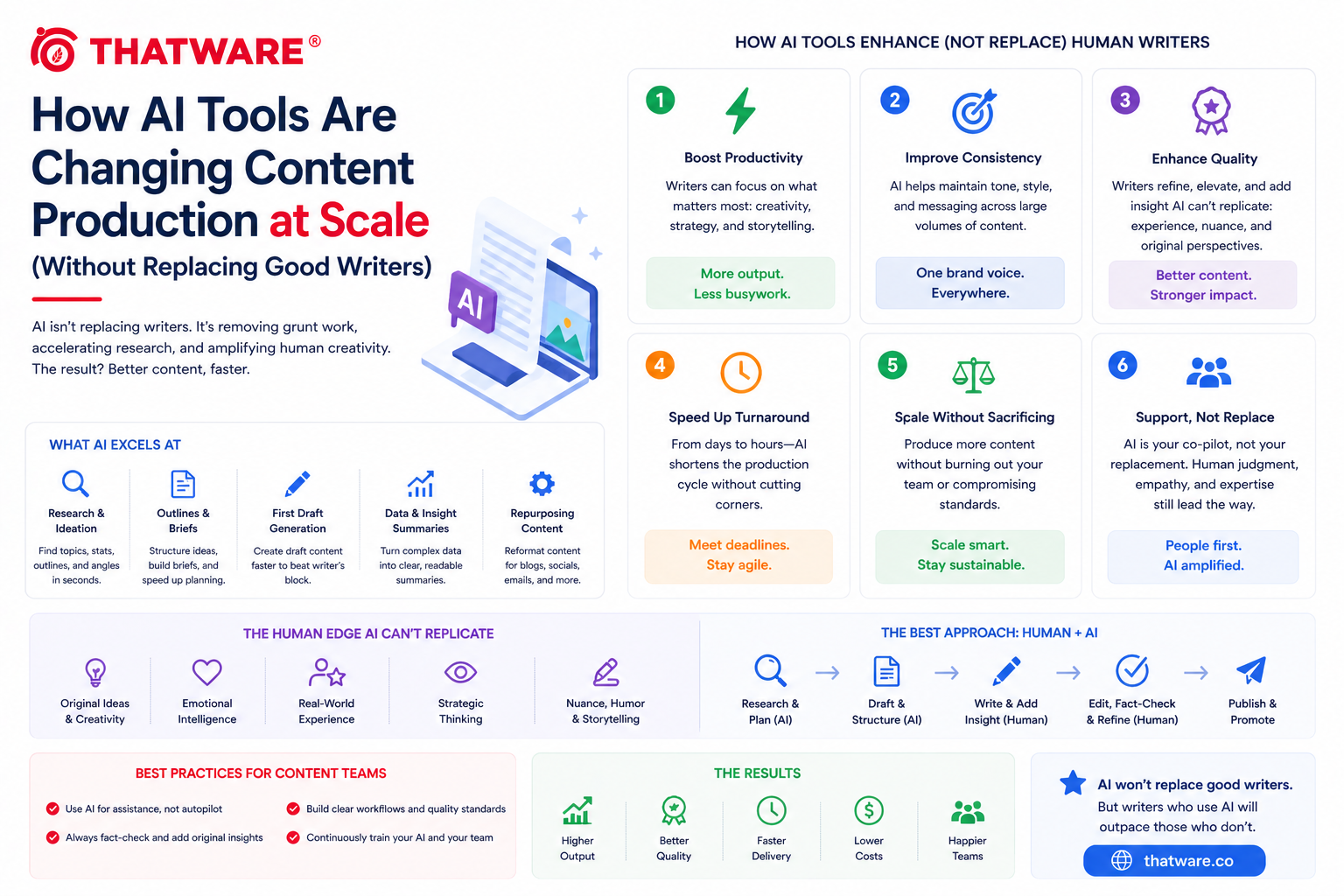
First draft velocity. A skilled writer using AI assistance for first drafts — not just accepting the output but using it as a starting point for editing and refinement — can produce significantly more content per unit of time than a writer working entirely from scratch. For high-volume content requirements (product descriptions at scale, FAQ content, templated informational content), this productivity gain is real and significant.
Research synthesis. AI tools are genuinely useful for synthesising information across multiple sources quickly, identifying the main perspectives on a topic, and providing a structured overview that a writer can then verify, expand on, and develop with original insight. The research phase of content production — previously one of the most time-intensive stages — can be substantially accelerated.
Variation and repurposing. Creating content variants for different audiences, different formats, or different stages of the customer journey from a core piece of content is something AI tools handle well. A long-form guide can be repurposed into social captions, email summaries, and FAQ content with minimal human editing if the source material is strong.
Structural ideation. Generating content structure options — heading hierarchies, angle variations, different approaches to covering a topic — is something AI does efficiently and that writers can use to accelerate the planning phase.
What AI Tools Are Not Good At
Equally important to understand: the specific areas where AI-generated content consistently fails without significant human editorial involvement.
Original insight and genuine expertise. AI tools synthesise existing information. They cannot produce original analysis, genuine expert perspective, or insight that comes from direct experience with the subject matter. Content that requires this — thought leadership, original research interpretation, genuine practitioner insight — requires human expertise, full stop.
Accurate factual content in specialised domains. AI models produce plausible-sounding content that is sometimes wrong, sometimes subtly wrong, and sometimes confidently incorrect in ways that are hard to detect without domain expertise. In any field where accuracy matters — healthcare, legal, financial services, technical documentation — AI-generated content requires thorough expert review. The productivity gains from AI-assisted drafting can be partially offset by the expert review time required to verify factual accuracy.
Brand voice consistency at the level that matters. AI tools can be prompted to match a voice, but they produce a generalised approximation of it rather than the genuine article. Brands with distinctive voices — ones that differentiate through how they communicate, not just what they say — find that AI-generated content needs significant editing to actually sound like them.
Content that requires genuine relationship and source development. Journalism, expert interviews, case studies, original research — any content that requires real-world sourcing rather than synthesis of existing material cannot be meaningfully AI-assisted at the sourcing stage.
The Content Quality Question and SEO
This is where the AI content debate intersects most directly with business outcomes.
Google’s helpful content guidance, reinforced through multiple updates, is explicit that it’s assessing content quality — whether content genuinely helps users, whether it demonstrates real expertise, whether it exists to inform users or primarily to capture search traffic. Content that’s clearly generated to produce volume without genuine editorial substance is increasingly being evaluated down in the quality signals that affect rankings.
This creates a specific risk for organisations that have deployed AI content without adequate human editorial oversight. High volumes of AI-drafted content that reads as synthetic — characterised by hedging language, generic structure, factual imprecision, and lack of genuine perspective — is not performing well in the current search environment, regardless of keyword optimisation.
Seo content writing services that use AI as a production tool but maintain genuine editorial standards — human expertise in content planning, thorough human editing of AI drafts, expert review of factual content, genuine quality control before publication — are genuinely using AI to improve efficiency without degrading quality. Services that have simply inserted AI generation into their production pipeline without this editorial layer are producing volume without corresponding value.
The Organisational Reality of AI-Assisted Content at Scale
For organisations producing content at significant volume — a content marketing agency india with large client portfolios, an enterprise brand with dozens of content markets, an e-commerce operation with thousands of product descriptions — the AI-assisted production model has changed the economics meaningfully.
What’s shifted: the ratio of writer time to content volume has changed. A writer who previously produced X pieces per month can produce more, if some of the more formulaic production work is AI-assisted and the writer focuses their time on the activities where human judgement matters most — ideation, structural planning, quality review, and the specific elements of each piece that require genuine insight or voice.
What hasn’t shifted: the need for editorial oversight, the need for subject matter expertise in specialised domains, the need for quality control before publication, and the need for genuinely skilled writers who can distinguish AI output that’s adequate from AI output that’s not.
The organisations that have deployed AI content tools most effectively are ones where experienced editors are using them to extend their own output — not organisations where AI has been used to reduce the need for skilled writers. The distinction matters, both for content quality and for the downstream SEO performance of the content.
Building the Right AI-Human Production Workflow
For organisations thinking about this seriously, the right workflow depends on content type and volume requirements.
For templated, high-volume content — product descriptions, FAQ responses, location pages, structured informational content — an AI-first, human-edited workflow makes sense. AI drafts at volume, human editors maintain quality standards and brand voice, subject matter review happens for specialised content.
For thought leadership, expert content, and competitive-environment long-form content — AI is a research and structuring tool, not a primary production mechanism. Human expertise and original insight are the core, AI accelerates the surrounding work.
For content in YMYL categories — any content touching health, finance, safety, legal matters — the standard should be expert-first with AI assistance in research phases only, and thorough expert review of all AI-produced elements before publication.
The key variable is the quality bar required. In low-competition, informational content environments, AI-assisted production with light editorial oversight produces adequate quality. In high-competition, YMYL, or brand-critical content environments, the editorial investment required to lift AI-generated content to the standard needed for performance is often greater than the efficiency gains.
The Writers Who Will Thrive
The AI content transition is real, and it does put pressure on certain types of content work. Highly formulaic, low-expertise content production — the kind that required effort but not genuine creativity or expertise — is the most exposed to AI displacement.
The writers who thrive in the emerging environment are the ones who offer something AI demonstrably doesn’t: genuine expertise in a subject area, distinctive voice and creative perspective, the ability to develop original stories and insights from primary research and interviews, and strong editorial judgement that can elevate AI-drafted content from adequate to good.
These capabilities aren’t going away. They’re becoming more valuable as the volume of average content increases and the premium on genuinely expert, genuinely distinctive content rises correspondingly.
The most useful way for content organisations — whether agencies or in-house teams — to think about AI tools is as productivity infrastructure that extends the output of skilled people, not as a replacement for skilled people. That framing produces better editorial decisions and, ultimately, better content.
Which is still what both readers and search engines reward.